
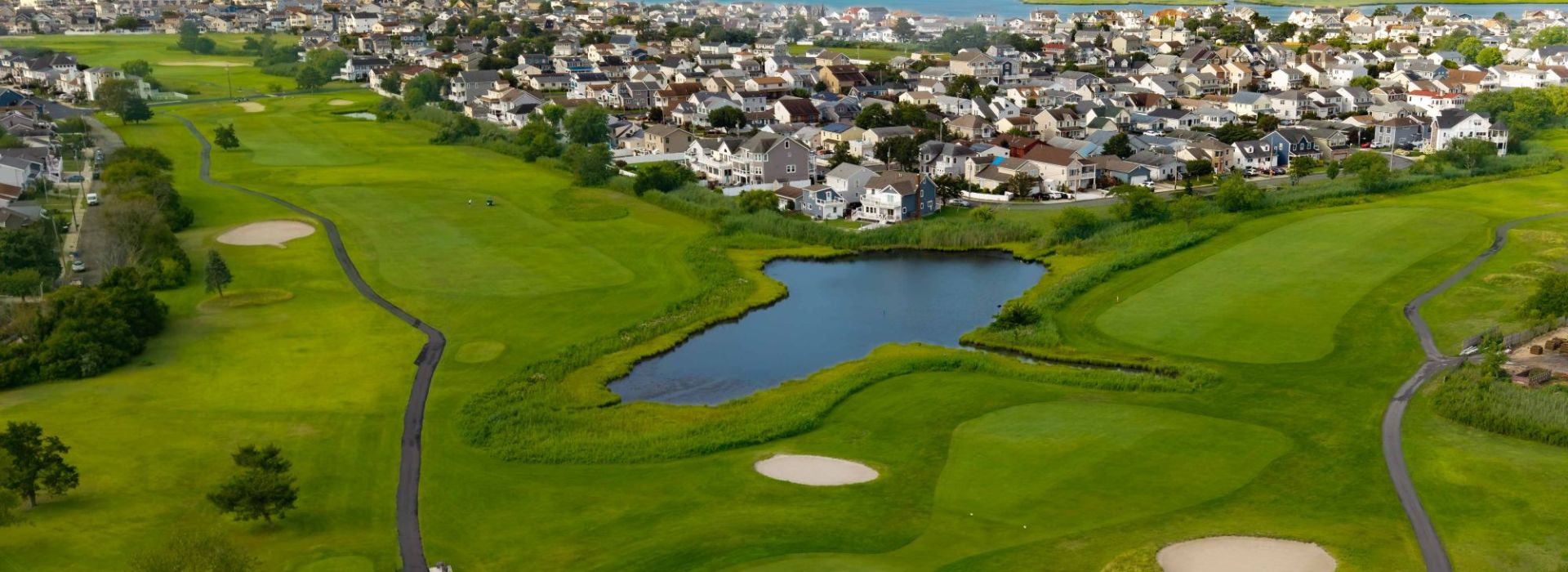
The History
Built in 1927 as part of the island’s master plan, The Brigantine Golf Links is unique in the Northeast with its Scottish links design by Wayne Stiles and John Van Kleek. Brigantine’s history is intertwined with the famed Scottish links courses of old. Local legend suggests that “Old Pros” from the 1920s practiced at Brigantine before sailing for the British Open.

Walter Hagen
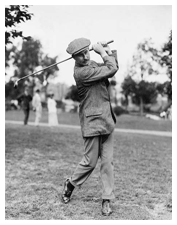
Harry Vardon
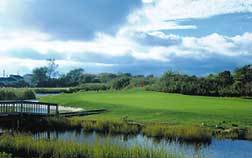
True to its historic Scottish roots, this layout offers breathtaking bay views, native marshland, and gently rolling, nearly treeless terrain. With prevailing sea breezes and carefully placed concave bunkers, this 18-hole, par-72 course provides an exciting and ever-changing experience for golfers of all skill levels.
Known as Brigantine Country Club for more than 60 years, the property was purchased in 1989 and renamed Brigantine Golf Links. The new owner undertook significant improvements, including fairway renovations, completion of cart paths, and construction of a new clubhouse. In July 2002, the property was acquired by the City of Brigantine, which contracted Meadowbrook Golf, Inc. to manage the facility and renamed it The Links at Brigantine Beach. Most recently, the City entered into a shared services agreement with the Atlantic County Improvement Authority to oversee management and maintenance of the golf course.
As of 2026, the City of Brigantine has assumed direct management of Brigantine Golf Links and has embarked on an ambitious long-range improvement program designed to enhance the course while preserving its unique links-style character. The City has retained renowned golf course architect Joel Weiman of Weiman Golf Design to develop a comprehensive master plan and long-term golf course improvement strategy. Planned enhancements include a complete tee renovation program and bunker restoration project aimed at improving playability, aesthetics, and course conditions.
Recent capital improvements have already transformed the facility, including the installation of a new irrigation system and extensive cart path renovations throughout the property. Looking ahead, the City is committed to continuing investment in this treasured community asset, with construction of a brand-new clubhouse scheduled to begin in the fall of 2026.
With these improvements underway, Brigantine Golf Links is poised to become one of the premier public golf destinations along the Jersey Shore while remaining a cherished amenity for residents and visitors alike.
Architect
In 1924, Wayne Stiles established — with partner John Van Kleek — the firm of Stiles and Van Kleek with offices in Boston, New York and St. Petersburg, Fla. The company continued to be involved in non-golf projects and often subcontracted work from Frederick Law Olmsted’s firm, although Stiles worked primarily on golf-related projects whereas Van Kleek focused on landscape design. Walter Hagen was at one time an associate of the firm.
Unlike Ross, who was known to design courses without ever visiting the property, Stiles was known for spending considerable time on his project sites. According to architect Geoffrey Cornish, whose career was just getting started as Stiles’ was winding down, Stiles often spent “weeks and weeks” walking the grounds, before a spade of dirt was ever turned, to “lay out the course with his eyes. He was a master at routing a golf course,” says Cornish.
Marshfield CC and Haverhill CC, north of Boston, have both undertaken great efforts in recent years to re-inject “Stiles ” features back into their layouts. So have Pine Brook and Woods Hole CC, on Cape Cod. Other Massachusetts public courses that retain a distinct Stiles flavor include Mink Meadows on Martha’s Vineyard, Putterham Meadows (now the Brookline Golf Club), Larry Gannon Municipal in Lynn (more than a flavor; a whole meal), Amesbury G&CC (a great 9-hole snack), and Salem Municipal, although again, Ross is often credited with designing this course.
Western Mass. could be considered the center of The Stiles Universe. The semi-private Taconic is stupendous (#2 on the NEJG Top 100), as is the front nine at Wahconah, in Dalton; Cornish built the back nine here using Stiles’ routing plan. Nearby, in Lenox, is the Cranwell Resort, Spa & Golf Club, designed by Stiles in 1926.
In Vermont, the semi-private Rutland CC remains relatively unchanged since Stiles turned an 1896 layout into the 18-holer. Like Taconic, Rutland shows off the architect’s uncanny ability to lay out comfortable golf holes on severely hilly terrain. Public, Stiles-designed courses dot New Hampshire, as well: funky Mojalaki near Franklin, Dover CC in the south, and Hooper GC to the west. Coastal Maine is a virtual feast of accessible Stiles, with great tracks located in interesting places such as North Haven Island, Boothbay Harbor, Bath, Rockland and Brunswick where, again, a Cornish nine complements the original with great elan.
Stiles’ last course, built in 1935, was Riverside Municipal in Portland, Maine. He died in 1953 at his home in Needham, Mass.
*information provided by Kevin Mendik, New England Journal of Golf*
Not everyone who designed the courses we call “classic” is accorded the honor and respect of, say, Donald Ross, Alistair Mackenzie and A.W. Tillinghast. Architect Wayne Stiles, for example, laid out some 60 courses and renovated 60 more during a distinguished but largely unsung career that coincided with golf’s “Golden Age” of course design (1915-1935). His work was “classic”, to be sure, and most of it was executed right here in New England. But, for some reason, his name fails to elicit the reverence we accord his luminous contemporaries. Stiles managed to fly just below the radar (in the considerable shadow of Ross) all his life. He laid out some of Greater Boston’s best private clubs (Thorny Lea, Woodland, Pine Brook), but none of the name joints — those jobs (Charles River, Salem, Winchester) went to Ross. Stiles pioneered the spread of public golf in New England, designing fabulous nine-hole tracks at relative backwaters like Brunswick in Maine, Wahconah in Western Mass. and Vermont’s Country Club of Barre. However, these and others were eventually expanded to 18 — by someone else, thus obscuring and, in some cases, diluting the fine work Stiles left behind.
Stiles’ enduring reputation isn’t helped by the fact that his most famous and decorated course, Taconic GC in Williamstown, is located far from the golfing mainstream in the remote northwestern corner of Massachusetts. Indeed, with its graceful features and strategic brilliance, many who have played Taconic assume it’s a Ross. Their styles were similar; many Stiles courses are commonly mistaken for Ross designs, but rarely vise versa. It was Stiles’ misfortune to work contemporaneously with the famous Scot.
However, there are “Stiles greens” (just as there are “Ross greens”) and they can be found all over New England. We may recognize the latter, but it’s high time we learned to identify and appreciate the former.
So the next time you’re playing a New England course that dates from the 1920s, keep an eye out for putting surfaces sited upon natural knobs. These are Stiles trademarks, as are fairway bunkers that only come into sight when one’s ball is located. He clearly had a soft spot for blind shots of all kinds: tee shots, approaches, even lay-ups. If these features are present, you may well be playing a course designed by Wayne Stiles, who isn’t a household name in New England golf circles, but deserves to be.
Born on June 22, 1884 in Boston, Wayne E. Stiles spent his professionally formative years as a draftsman with the Boston firm of Brett and Hall, ending up as a junior partner involved primarily in city planning and Canadian land subdivisions. He essentially learned the trade of landscape architecture without formal schooling. Nevertheless, in 1915, he formed his own landscape design firm on Newbury Street and became a Junior Member of the American Society of Landscape Architects, becoming a Fellow of ASLA in 1921.
By 1916, he had become involved in golf course design — not surprising considering the tremendous boom in course construction at that time. His earliest layouts came in 1916 when he completed nine-hole courses at the Brattleboro (Vt.) and the Nashua (N.H.) Country Clubs. He is not credited with any further golf projects until 1921, his hiatus coinciding with the USGA’s 1916 ruling that essentially removed the amateur playing status of golf course architects who received fees. Stiles was a fine player. For years he maintained a 4 handicap at his home course, Brae Burn, a Ross design in Newton, Mass., where Ross maintained a membership to his dying day. Even at his home course, Stiles couldn’t seem to avoid Dornoch’s favorite son.
This USGA ruling was reversed in 1921, and the Roaring 20s were clearly the most prolific for Stiles, as they were for golf course construction throughout the U.S. During this period Stiles would design layouts from Maine (Prout’s Neck GC) to Florida (Lake Jovita CC), and as far west as Missouri (Northwood Hills CC).